CACOVID Donates N250m Medical Equipment To Oyo

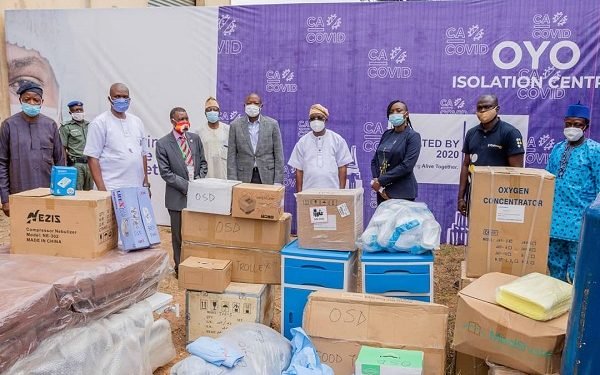
The Coalition Against COVID-19 (CACOVID), a private sector initiative established to fight the COVID-19 pandemic, has donated N220 million medical equipment to the Oyo State Government.

CACOVID also donated N30 million to the state government.

The CACOVID team lead in-charge of Oyo and Osun states, Dr Timothy Aroowogun, made the donation on behalf of the coalition.

“The objective of donating the equipment is to support the state government in eliminating COVID-19, help the citizens and also help the health workers to contain the pandemic in the state.

“The First Bank Nigeria Limited, as a frontline member of the CACOVID initiative, is partnering with the government to provide the much needed support in the fight against COVID-19 in order to stop the spread of coronavirus in the country,” he said.

Receiving the donation, Governor Seyi Makinde, represented by his deputy, Rauf Olaniyan, appreciated the CACOVID team for the initiative.

He gave an assurance that all the donated medical equipment and supplies would be deployed to the soon to be opened Saki 100-bed isolation and treatment centre.

According to the governor, the opening of an isolation centre in Saki is strategic due to its location as a border town to neighbouring West African countries.

“The Saki Isolation Centre is going to be three-in-one. It will have what you call an observatory and isolation and treatment centre.

“The reason we need to have an observatory is because Saki is a border town and many people come in from different parts of the West African states, especially Burkina Faso and Benin Republic, they come in through that area,” he said.

In his remarks, Prof. Temitope Alonge, a member of the Oyo State COVID-19 Task Force, described all the equipment donated as appropriate for the treatment pattern being followed in the state in the fight against COVID-19.

Alonge said: “What thrilled me is that the CACOVID team took cognisance of the disease pattern that we are managing and decided to provide equipment that are appropriate.

“On many occasions, people have made donations that are good on paper but in terms of usefulness, probably not as good.

“But what they have done is to provide everything from the most mundane to the expensive ventilators, which are all going to be utilised for the management of this disease.

“And to top it all, they brought us about 40 cylinders of oxygen, meaning for the next one year or thereabout, there may not be need for the Saki Centre to run to Ibadan to come and collect oxygen.”

Some of the equipment donated were Lead ECG electrode, heavy duty apron, autoclave, auto syringe pump, biohazard bag, blood warmer, centrifuge (refrigerator), defibrillators (AED) and portable ultrasound imaging.

Others include mobile digital x-ray unit, face shield, protective goggles, hospital gowns, oxygen cylinders, wheelchairs, oxygen concentrator, oxygen regulators, nebuliser, kidney dish, patient multiparameter monitor, stretcher and suction devices.
Corona Virus: Adjust Or Die

COVID-19 could have been a global health challenge.  That is bad enough, with the pandemic altering life and living, more than any single phenomenon, in living memory.

But its real pestilence would appear economic.  It is getting clear: COVID-19 won’t leave the globe in a hurry.  But even after it does, its economic plague would linger.  That is grim news already making 2020 a year to forget, even when it is barely half-year.

The effect of COVID-19, as a rippling, ruthless job tornado, is underscored by the latest stats from the National Bureau of Statistics (NBS), which states 42 per cent of Nigerian workers have lost their jobs, no thanks to the COVID-19 storm.

By that NBS survey, 42 per cent of those polled said they lost the jobs they had, pre-COVID-19.  That’s a breath short of half of the putative working population.  Now, add underemployment — vastly reduced clientele/customer traffic, no thanks COVID-19 lockdown at its highest.

Add temporary job losses, from forced leaves, to be reviewed as the pandemic peters out.  Add even salary cuts, forced by businesses’ lower earnings, as a result of diving sales and vanishing clientele, and you could be talking of a cumulative range of about 55 per cent to 60 per cent.  That is no gravy to savour!

Of course, it goes without saying, the follow-up NBS finding: that 79 per cent of the polled respondents (that’s almost four out of every five) revealed their income had taken a hit, since mid-March, when the COVID-19 emergency started in the country.

Again, it logically follows: lower income translates to lower demand of goods and services. Between 35 per cent and 59 per cent of the respondents said they found it increasingly difficult to buy routine staples — rice, yam and beans — to feed.  Another 26 per cent said they could no longer afford medical treatment.

So, no thanks to COVID-19, the poverty situation is worsened, with a section of the poor no longer able to afford the little food they could hitherto muster.  This segment of the population also progressively gets crowded out of the healthcare market.

Thus, COVID-19 is a double-whammy, among the most vulnerable: increased poverty and decreased wellness!  When slightly more than half of the population (51 per cent resort to reducing food consumption: enduring some form of hunger) and another (26 per cent) cut down on medical needs, and probably resort to self-medication), then you have a grim situation.

O dear!  The medical market gets attacked from two ends.  If less people than hitherto could afford hospital services, it logically follows that each hospital would earn less cash to pay its medics: doctors and nurses, not to talk of the paramedics and other back-up staff.

Then the direct impact: fear of cropping COVID-19!  Many private clinics have closed shop, simply because they can’t muster the additional COVID-19 protective kits.  That is temporary job losses for the clinics involved.  It could also mean a severe business-changing blow, for those clinics would have to summon more capital to procure those gears (yet are faced with lower earnings).  If they hope to be in business, post-COVID-19, they are faced with a completely altered business paradigm!

Surely it’s not the best of times?  That is why it calls for radically new thinking that would trigger the capacity to adjust.

Indeed, adjust or die!  That would be the COVID-19-19 battle cry, even well into the post-COVID-19 globe!  It’s not the best of times!

Kaduna State Govt-“We Are Still In Lockdown”

The Kaduna State Government has disowned a document that has been making the rounds, stating that the Quarantine Law has been reviewed and that 12-hour lockdown is now in place.

The document, which the government described as fake, claimed that the lockdown is now from 6pm to 6am but that interstate travel remains banned.

The Special Adviser on Media and Communication, Muyiwa Adekeye on Sunday, said several people have called government officials to enquire about the authenticity of the document that has gone  viral on social media platforms.

Adekeye stated categorically that, ‘’the Quarantine Order remains in force until Tuesday, 9 June, 2020 when the two-week extension expires.

“Until then, the lockdown remains in force. The night-time curfew also remains in force, until the government announces otherwise,’’ the Special Adviser warned.

GIST: Buhari- Why Appeal Court Acting President Is Yet To Be Confirmed

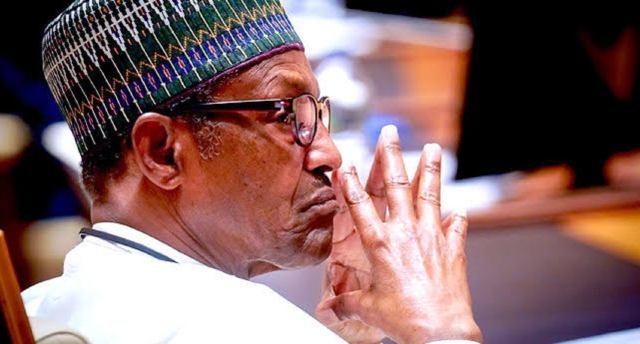
President Muhammadu Buhari has explained why the Acting President of the Court of Appeal, Justice M. S Dongban-Mensem, has not been confirmed.

There had been insinuations Buhari was likely to bypass Dongban-Mensem, a northern Christian, for the next person in line, a northern Muslim as President of the Court of Appeal.

Former Military Governor of Kaduna State, Col. Abubakar Dangiwa Umar, in a public letter to Buhari on May 31, accused the President of making “skewed appointments”, warning they may plunge the nation into ruin.

He said Dongban-Mensem “appears eminently qualified for appointment as the substantive Chief Judge of the Court of Appeal as she is also said to be highly recommended by the National Judicial Council.”

But reacting to the allegation of skewed appointments on Sunday evening, Senior Special Assistant to the President on Media and Publicity, Mallam Garba Shehu, ruled out ethnic or religious considerations in Buhari’s choices of appointments.

He said Dongban-Mensem was could still function as acting President of the Appeal Court within the specified period while security checks and other laid down protocols were being carried out.

“In making appointments upon the recommendations of other arms or agencies of the government, the President is not a rubber stamp that will mechanistically sign off on nominees that come before him.

“The President has a duty to ensure that all such appointments meet the requirements of the Constitution and protecting the supreme law of the land in this regard, he has an obligation to allow law enforcement and security agencies to do their work.

“Don’t forget our recent experience with ministers who were signed off upon and turned out as having not undertaken the compulsory National Youth Service, just to give you an example.

“In the specific case of the Acting President of the Court of Appeal, Her Lordship Justice M. S Dongban-Mensem, the statutory regulatory time of her acting period has not lapsed.

“This is not about ethnicity or religion. It is about security and law enforcement agencies being allowed to complete their work. Nobody should seek to stampede the President in carrying out his constitutional duty in this respect.

“The President had not been a rubber stamp dealing with these matters before, and is not prepared to be one at this time. Let all allow the system to do what is right,” the statement said.

COVID-19: CBN Earmarks N50m Grant For Herbal Medicine Research

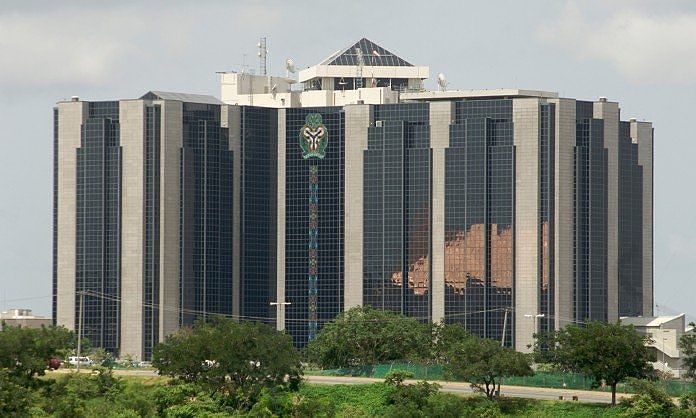
Researchers into herbal medicines and vaccines for COVID-19 can now access N50 million grant from the Central Bank of Nigeria (CBN).

The CBN in the guidelines released at the weekend, said research activities will attract ?50 million, while development/manufacturing activities will attract a maximum of N500 million.

According to the guidelines “disbursement under the scheme shall be made to beneficiaries in tranches subject to achieved approved milestones.”

Once the grant is awarded to researchers and/or developers, the CBN said it will “have proprietary right over all financed R&D outcomes or products.”

Also, licensing protocol for the mass manufacturing of developed drugs, phytomedicines and vaccines, the CBN said “shall be defined by the Body of Experts (BoE) in accordance with the World Health Organisation’s current Good Manufacturing Practices (cGMP).”

The guidelines state that Body of Experts (BoE) shall be responsible for the review and evaluation of submitted research proposals.